Many years ago when I started out as a novice writer, I had one rule.
If the idea wasn’t original, it wasn’t worth writing.

So I waited. Sometimes for hours. Often for days. I’d sit with a blank page and wait to think about something that nobody had ever said before. And since ideas like that almost never arrive on schedule, I mostly didn’t write at all.
I wrote far less than I wanted to or I should have. Not because I had nothing to say, but because I’d decided that what I had to say wasn’t new enough to count.
It took me a long time to see how much that rule had cost me.
The rule I never questioned

The strange thing is that I never asked where the rule came from.
It just felt true. Good writers have original ideas. Great artists create from nothing. Everyone else copies.
If you’d asked me back then, I would have said that was simply what quality meant. Saying something someone else had already said felt like cheating, or at best like a waste of the reader’s time.
So I filtered almost every idea out before it reached the page.
Nothing is original

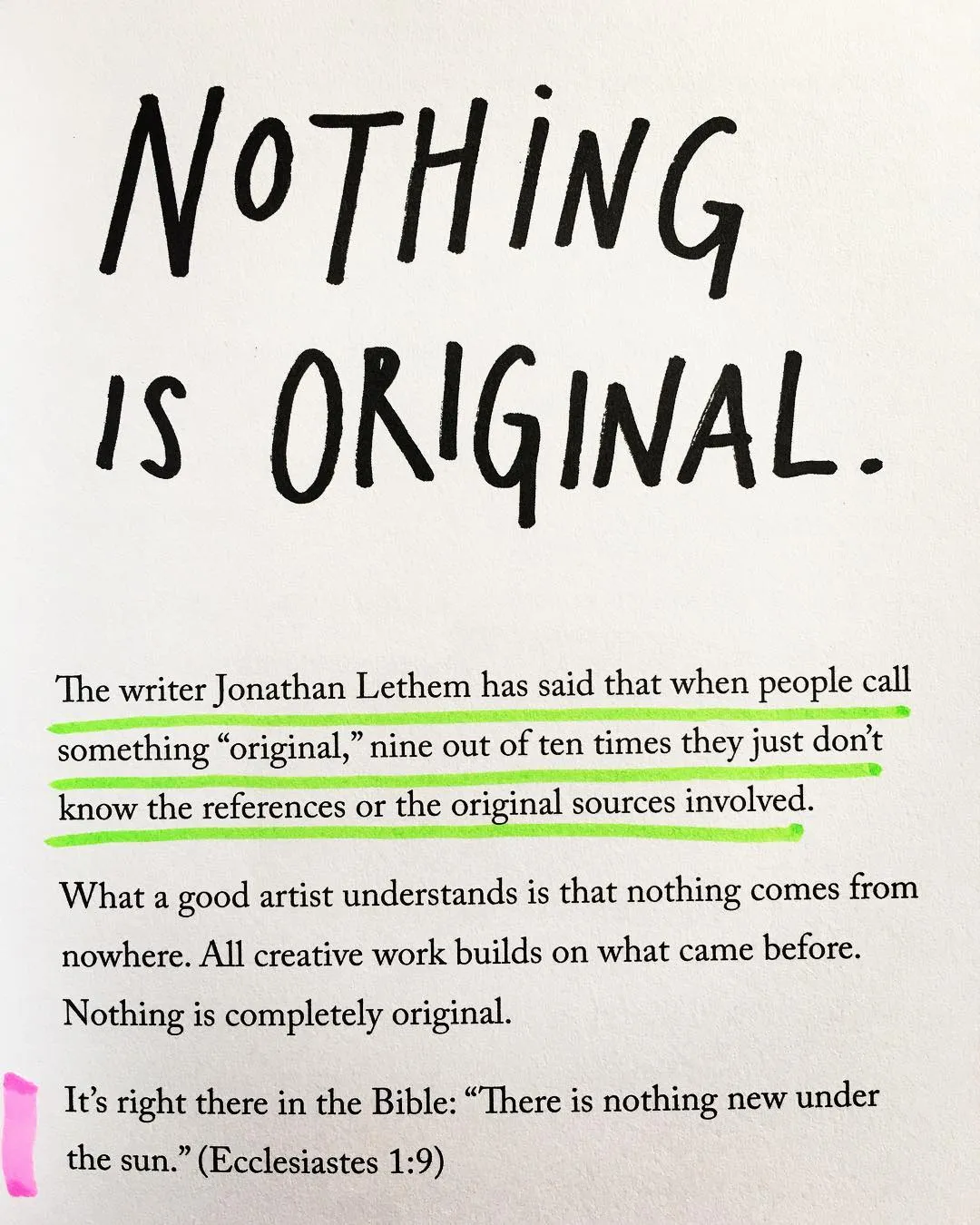
Years later, I came across a page in Austin Kleon’s Steal Like an Artist that said, in a few lines, what I had taken years to work out.
Kleon points to the writer Jonathan Lethem, who has said that when people call something “original”, nine out of ten times they just don’t know the references or the original sources involved.
Then Kleon adds the line that stayed with me: nothing comes from nowhere. All creative work builds on what came before.
He even backs it up with a source that proves the point by being old. “There is nothing new under the sun.” That’s Ecclesiastes 1:9, written more than two thousand years ago.
That was the first thing I had to accept.
Nothing is truly original. We just don’t know the source.
When something feels original to us, it usually means we haven’t met its ancestors yet. The idea has a family tree. We’re just seeing one branch.
Shakespeare is the classic example. Romeo and Juliet wasn’t his plot. He worked from Arthur Brooke’s long poem, The Tragical History of Romeus and Juliet, published in 1562, which itself came from earlier Italian stories. Nobody calls Shakespeare unoriginal. They call the play his.
Which brings me to the second thing.
The originality is in the interpretation

This one took me longer.
If nothing is original, then what is? What makes one piece of writing feel fresh and another feel like a copy?
My answer now: it’s not the idea that’s original. It’s the interpretation.
The idea is the raw material. What you bring to it is the work. Your experience. Your examples. The mistakes you made that taught you something. The angle you could only have found because of where you’ve stood.
Give ten people the same idea and ask them to write about it honestly, and you’ll get ten different pieces. The idea is shared. The interpretations aren’t.
This post is an example. The idea that nothing is original is not mine. It’s Kleon’s, and Lethem’s before him, and the author of Ecclesiastes before both. What’s mine is the years I spent waiting at a blank page, and what it felt like to finally stop.
That part, nobody else could have written.
Who put originality on a pedestal?

Once I accepted all this, a different question started bothering me.
Where did this pressure come from in the first place? Who decided that originality was the bar? Who put it on a pedestal?
I went looking, and the answer surprised me. As far as I can tell, the pedestal is fairly recent.
For most of history, imitation wasn’t something to hide. It was how you learned. Students in the classical and Renaissance traditions were taught through imitatio: you studied the writers you admired, copied their forms, and slowly found your own voice inside them. Borrowing was the method, not the failure.
Things began to shift in the 18th century. In 1759, the English poet Edward Young published an essay called Conjectures on Original Composition. His argument, roughly, was that an original work grows from the writer’s own genius, while an imitation is manufactured from someone else’s. Originals were worth more.
The Romantic writers and artists who followed ran with it. They built up the image we still carry today: the lone genius, struck by inspiration, creating something from nothing.
Around the same time, the law was also starting to treat writing as property. Britain’s first copyright law, the Statute of Anne, came in 1710. Once an author could own a work, it mattered a lot more whether that work was “theirs”.
I’m simplifying a long history here. But the shape of it is clear enough. The idea that real work must be original, and that borrowing is shameful, is only a few hundred years old. It’s not a law of nature. It’s a cultural story.
And like a lot of cultural stories, it does some good and some harm. It rewards people who push into new territory. It also quietly stops a lot of people from starting at all.
I was one of them.
What I’d tell my younger self

If I could go back to that version of me, staring at a blank page, waiting, I’d tell him three things.
1. Start with someone else’s idea. It’s not cheating. It’s how almost everything begins. Read something that moves you, and write about why.
2. Credit it, clearly. Borrowing and stealing are different things. Naming your sources isn’t a weakness. It shows the reader where you’re standing, and it frees you from pretending you invented the ground.
3. Write until you find the part that’s yours. It’s usually there, in a story, an example, a disagreement, a mistake. It just doesn’t show up while you wait. It shows up while you write.
The good news

“Nothing is original” can sound like bad news. As if everything worth saying has already been said.
I’ve come to read it the other way.
If nothing is original, then nobody is starting from nothing. You don’t have to invent a new idea before you’re allowed to speak. You only have to bring yourself to an old one, honestly.
That’s a much lower bar to start, and a much higher bar to do well. Which is exactly how it should be.
I wish I’d known that many years ago. I would have written a lot more.
What’s an idea you borrowed that only became yours once you wrote about it?