
A few weeks ago, I upgraded to Canva Business. And for the first time since 2012, I did not renew my Adobe Creative Cloud subscription.
That sentence took me longer to write than it should have.
I have been a user since the mid-2000s. I worked there. I hold the stock, and a meaningful portion of whatever financial security I have built comes from RSUs I earned during my time at the company. Which means my personal financial wellbeing is, uncomfortably, directly tied to an ADBE that has lost 53% of its value over the last five years.
I am not a critic writing from the outside. I am someone who was inside the building, paid for the product for nearly two decades, and still checks the stock price with a kind of involuntary hopefulness. This is not a takedown. It is something closer to grief.
And grief, I’ve found, is easier to process when you understand what actually went wrong.
There’s a specific kind of meeting I remember from my time at Adobe.
Someone would share a design, a landing page, a learn page, a piece of content, and before any other feedback arrived, someone in the room would ask: “But why should the user need to scroll this much?” Or: “What does the user feel here, right at this moment?” The conversation always came back to that. Not the brief. Not the deadline. The user.
That wasn’t a cultural quirk. It was the operating system. The people I worked with genuinely believed their work mattered to the people on the other side of the screen. I have no reason to believe that has completely changed. The people still care. I suspect many of them still ask those exact questions.
What changed wasn’t the people. What changed was what the company decided to optimise for.
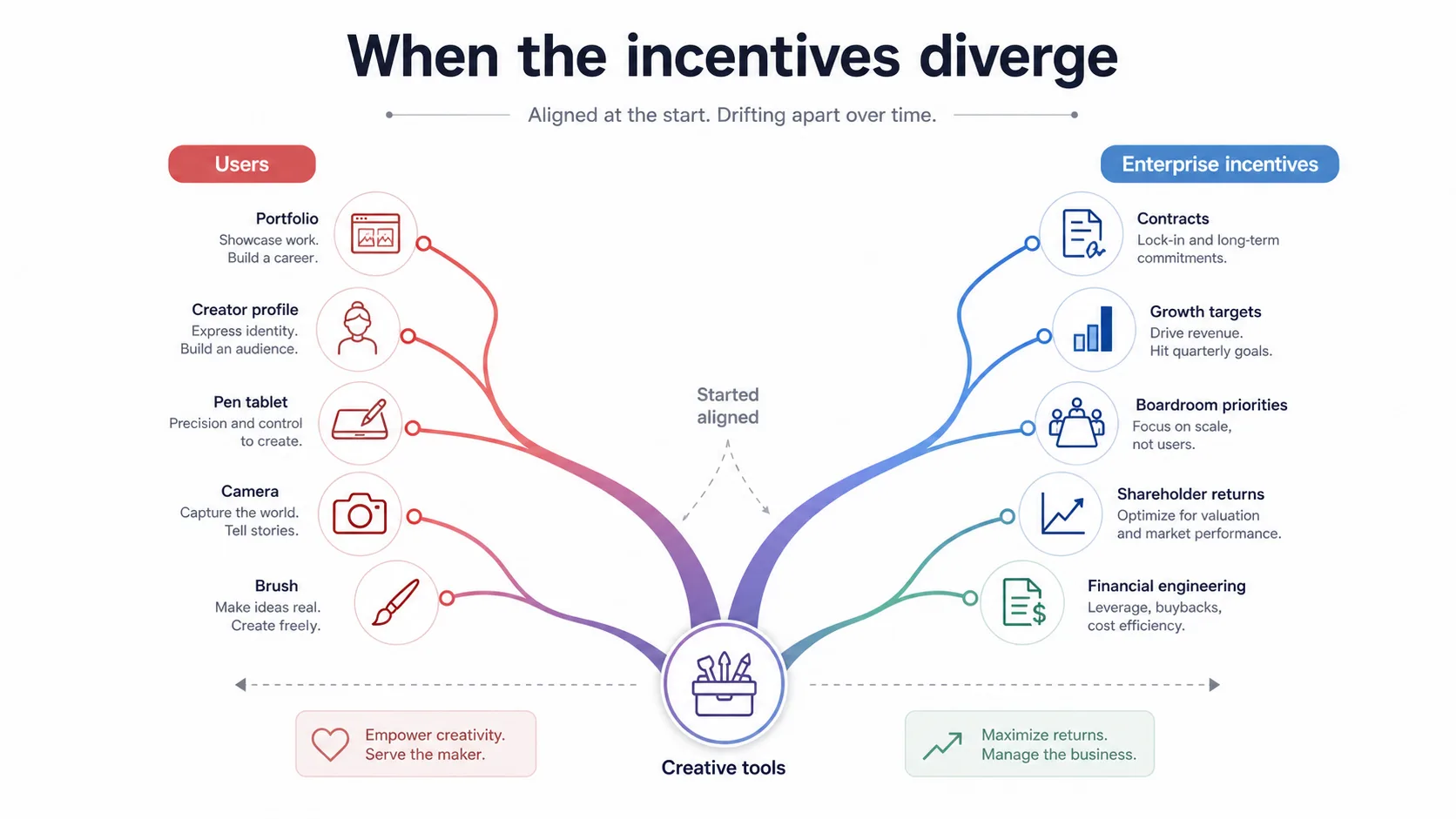
When the incentives diverge
This is a well-documented failure mode in economics. It’s called a principal-agent problem. The principals (the users who built careers on Adobe software) want the company to keep making tools that serve their creative work. The agents (the leadership layer) have their own incentives: enterprise contracts, analyst approval, stock price, board optics.
For a long time, those two things were aligned. Happy users meant growth meant happy shareholders. The machine worked.
But at some point, Adobe’s leadership discovered something more efficient: enterprises. A single enterprise contract is worth millions. A photographer in Indiana is worth €60 a month. If you’re running a business and you can choose where to direct your resources, the math writes itself.
The problem with that math is what it quietly costs you. You start changing your communications team. You replace the PR firm that knew how to talk to artists with one that knows how to get into the magazines that CFOs read. You stop putting your engineers in front of users at events and replace them with media-trained executives who’ve never touched the software. Your terms of service start being written by lawyers rather than humans.
None of this is malicious. It’s rational, given the incentives. That’s what makes it so hard to reverse.
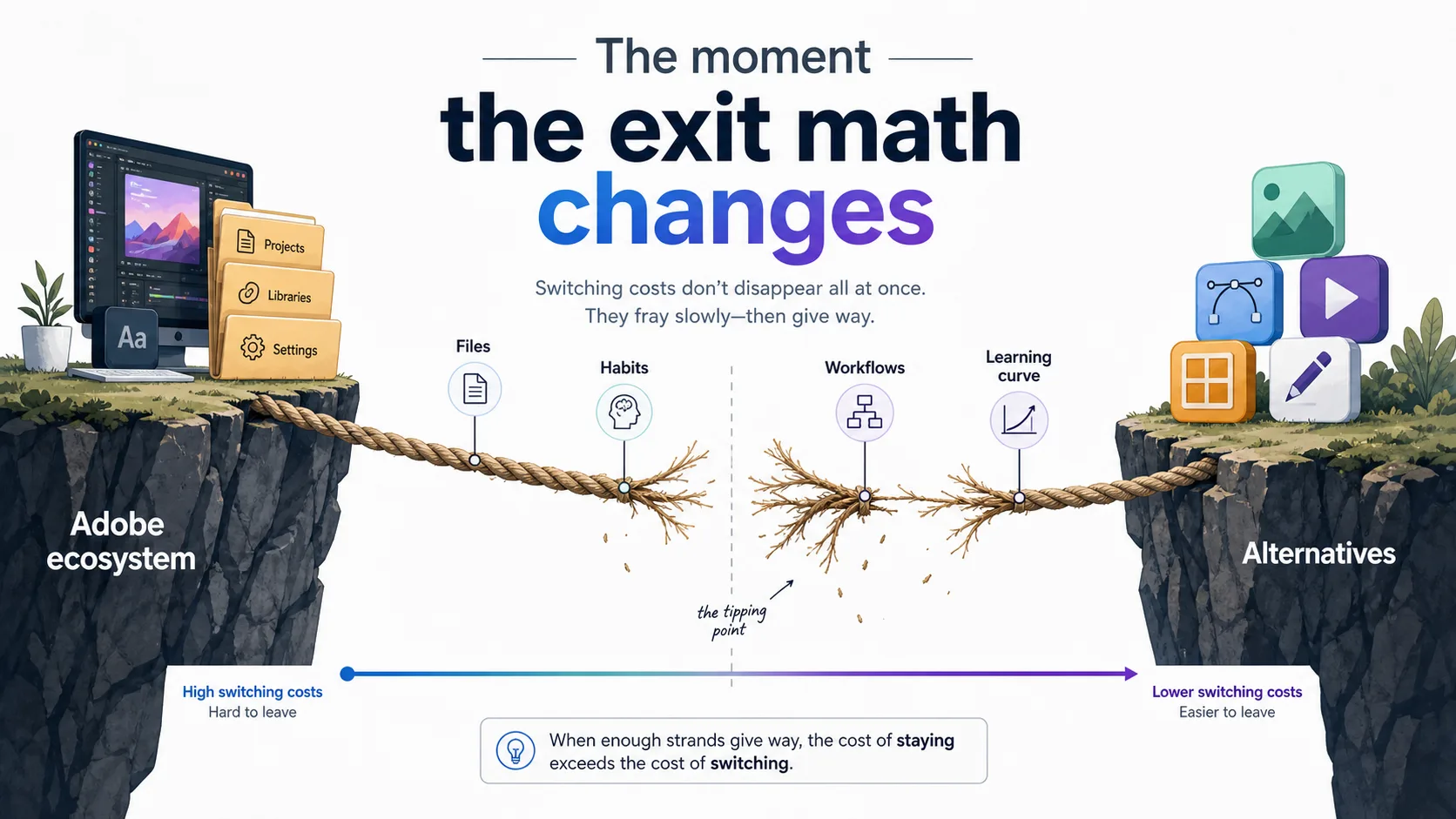
The moment the exit math changes
Here is where my economics training becomes useful.
Adobe built, over decades, one of the most formidable switching cost structures in the history of software. Entire industries learned to work in Photoshop. Entire workflows depended on InDesign. An entire generation of creatives can’t think in anything else. That’s not product quality. That’s lock-in. And lock-in is enormously valuable, right up until it isn’t.
The thing about switching costs is they don’t disappear. They erode. Slowly at first, then quickly, the way a rope frays. Every subscription price increase is a small piece of that rope. Every term of service controversy. Every “skip the photo shoot” campaign that told photographers they were replaceable. Every year that competitors got better.
At some point, a user opens a spreadsheet and does the math. They ask: what does it cost me to stay versus what does it cost me to leave? For years, that calculation was easy. The cost of learning new software, converting files, rebuilding workflows was too high. So you stayed. You grumbled. But you stayed.
That calculation is no longer easy.
DaVinci Resolve exists. Affinity exists. Canva, the company I currently work with as a consultant, is building aggressively. Apple is moving. The cost of leaving has dropped. And Adobe, by relentlessly raising prices and quietly walking away from the users who loved it, has been steadily raising the cost of staying.
That’s demand destruction. Not dramatic. Not sudden. Just the slow, inevitable consequence of optimising for extraction over value.
The part I find hardest to sit with
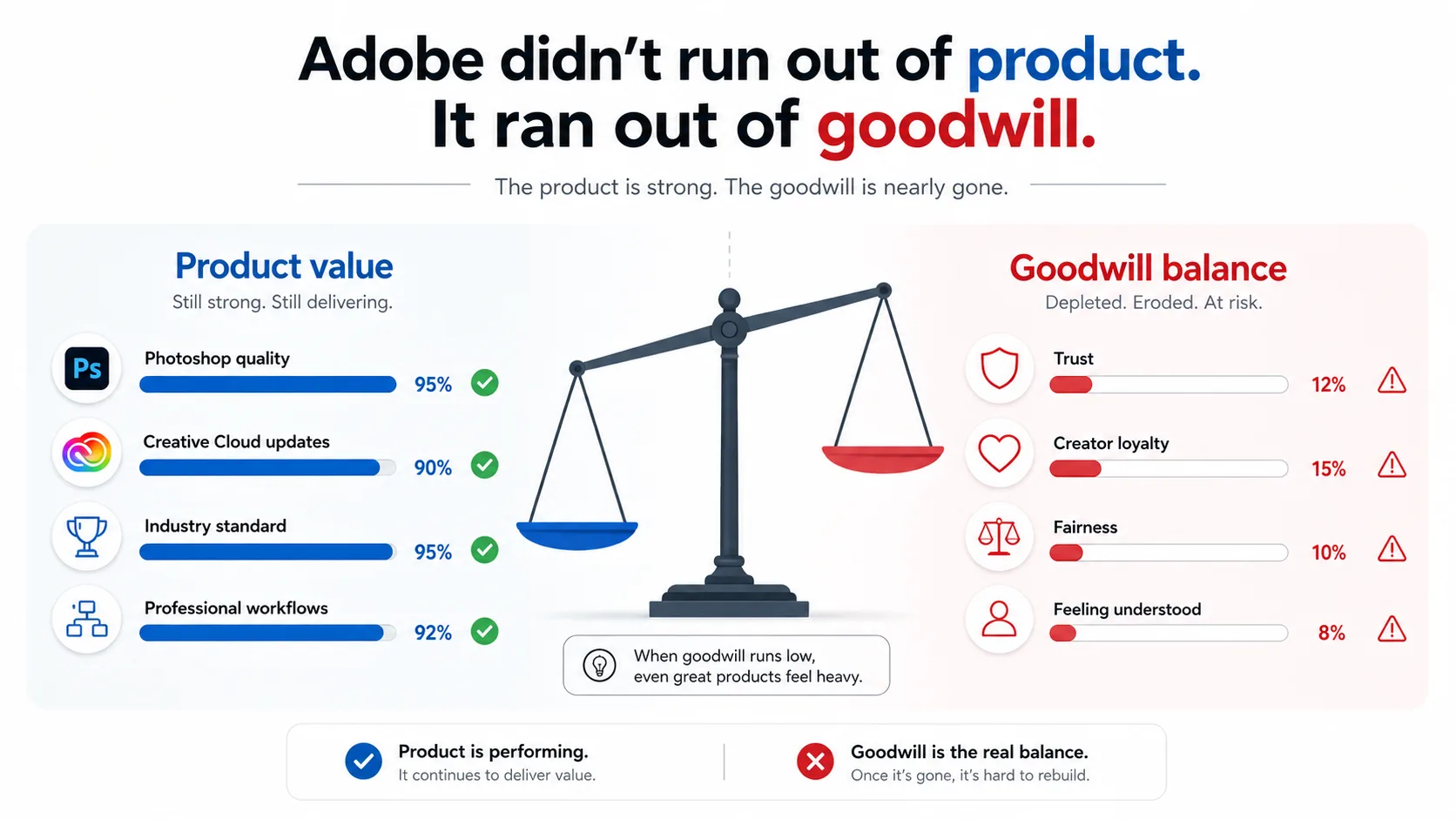
The product is still good. In many ways it’s still great. Photoshop has not gotten worse. Premiere has not stopped working. The promises Adobe made in 2013 when it moved to Creative Cloud, that updates would come faster and the software would stay current, were largely kept.
That’s what makes the business decisions so strange to watch. The product team held up their end. The executive layer didn’t hold up theirs.
I’m doing the math now. Not out of anger, and not out of loyalty to any competitor. Just because the exit math has changed, and I’m a rational user. The same user Adobe once designed every scroll, every page, every learn flow for.
I want the company to fix this. And I am simultaneously part of the data that proves it needs to. That tension doesn’t resolve neatly. I’ve stopped trying to make it.
What happens next
In technology, there is always a new emergent. The AI tools Adobe itself is selling are the same tools that let a competitor build a credible alternative in a fraction of the time.
Adobe is not standing still. At Summit 2026, they launched a Creative Agent on Firefly, an agentic CX Enterprise system, and acquired Semrush. The stock is ticking up from its 52-week low. Analysts see 42% upside.
But the Creative Agent aside, most of these moves are aimed at the enterprise buyer, not the maker. The recovery thesis is built on earnings models, not on users coming back.
Adobe didn’t run out of product. It ran out of goodwill. And goodwill, it turns out, was the asset that mattered most.
I’m watching the stock tick up. I’m reading the Summit announcements. And I’m still on Canva.